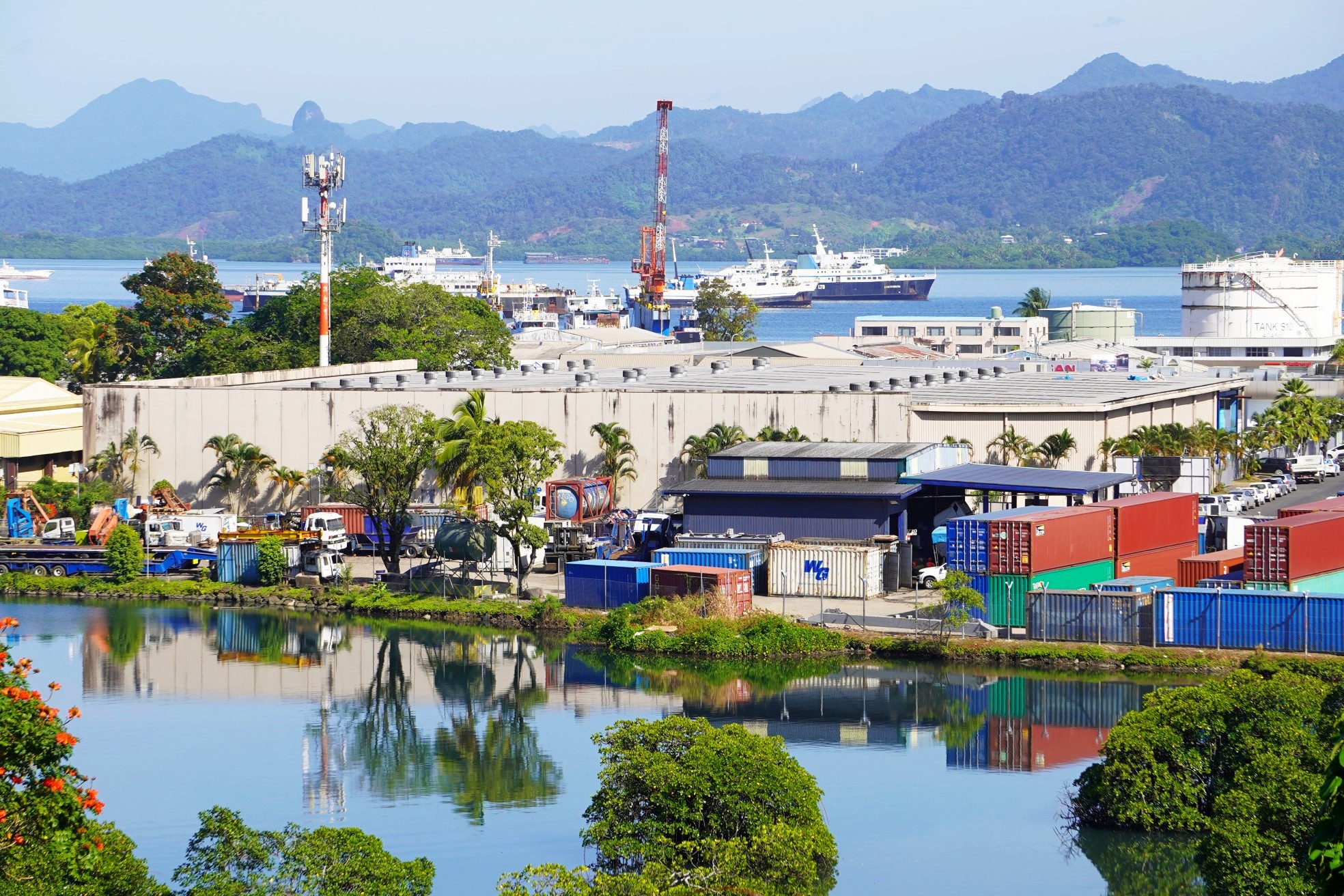
The economic and cultural capital of the South Pacific, Fiji’s capital Suva doesn’t offer the tropical island experience that the country is best known for, but has a number of historic sights of interest.

To start in the city centre with Ratu Sukuna Park, a lovely waterfront and central park, which is probably the best maintained in Suva. It is named after Ratu Sir Josefa Lalabalavu Vanayaliyali Sukuna KCMG KBE, a Fijian chief, scholar, soldier, and statesman. He is regarded as the forerunner of the post-independence leadership of Fiji. The park has a flash stage and excellent (free) public toilets, plus shade under ancient trees. The park was developed in 1955 through land reclamation along the Suva foreshore, and upgraded in 2024 at a cost of $7m.


Heading south, and running around much of Suva’s coast is the Suva Seawall, a very pleasant place to walk and run.


At low tide in particular there is plenty of wildlife to see.


In the distance is the mountainous interior of Viti Levu, the largest Fijian island, with Suva located on the south east coast.


The moored Tikos Seafood Restaurant is a notable sight by the seawall.


Fiji Museum is a good place to learn about the history of the country.


The museum is in the grounds of the attractive Thurston Gardens, along with a sizeable Clock Tower.


Next door is Albert Park, which seems to be constantly in use for rugby or cricket games.

It is overlooked by the Parliament Of The Republic Of Fiji, a complex built in 1930s.


Across the road is the Grand Pacific Hotel, which opened in 1914. Along with much of the city centre, it is built on reclaimed mangrove swampland.


Fiji’s Government House is set well back from the main road, behind beautiful grounds, home to bat filled trees.


Central Suva is a mixture of the historic and modern, and heaving with people six days a week, and near deserted on Sundays with most places closed.


Cumming Street is well known for heritage buildings.


The Suva City Carnegie Library was opened in 1909 and bears the name of the Scottish-born American philanthropist who funded it. It is now run by the Suva City Council and serves the Central and Eastern Divisions of Fiji.


Suva Municipal Market is one of the best markets I’ve visited, with a wide range, and clear pricing!


Suva is home to four notable churches, the Catholic Sacred Heart Cathedral. Construction started in 1894 but the sandstone structure (largely imported from Australia) wasn’t completed until 1939.


St Andrews Presbyterian Church is one of the oldest surviving wooden buildings in Suva, and was constructed in 1883 soon after the capital was established. The previous capital had been in Levuka, on Ovalau island, but the town was geographically constrained.


Holy Trinity Cathedral is the cathedral church for the Anglican Diocese of Polynesia in Suva. It is notable for its boat-shaped interior, Fijian tapestries, and wood-beamed ceiling, though I’m not sure that the tropical climate has been kind. Construction started in 1940 and it was consecrated in 1953.


The Centenary Methodist Church was announced in 1935 during the Centenary celebrations of the first Wesleyan missionaries who arrived in Fiji. Fundraising for the church started in 1950 and the church was opened in 1954.


Fiji’s population follow many faiths, in part due to the significant Indo-Fijian population, which was established by the British encouraging Indians to migrate to Fiji to work on sugar-cane plantations between 1879 and 1916. There are a number of Hindu temples, including the colourful Laxmi Narayan Mandir.


Shirdi Sai Mandir is an attractive Sathya Sai Baba temple, often referred to as a Sai center or ashram, a spiritual institution dedicated to the teachings of Sathya Sai Baba. Sri Sathya Sai Baba was born on 23rd November, 1926 at Puttaparthi village in Andhra Pradesh. Initially known as Sathyanarayana Raju he took on the name Sathya Sai Baba later. The meaning of ‘Sathya’, ‘Sai’ and ‘Baba’ is Truth, Mother and Father respectively. He exhibited differences from his companions at an early age and frequently led his school friends in worship and chanting spiritual songs as their ‘Guru’.


A substantial Hare Krishna Temple opened in late 2004, at a cost of $3m. The Sri Radhagolokabihari Temple complex comprises three buildings, with the main temple able to hold 700 people. Fiji has the highest percentage of Hare Krishnas per capita in the world.


There are also a number of mosques, including Toorak Jame Masjid and Masjid Noor.


A short bus ride, or steep walk, north of central Suva is the dense suburb of Samabula, home to a number of religious sites of interest. The highest is the Mormon Temple, whose golden statue of the angel Moroni is visible when entering Suva on the main road. The Church of Latter Saints have been in Fiji since 1953, with the first branch established in 1955, and now has around 12,000 members. The temple was opened in 2000, and was the first in Melanesia.


The Hindu temple of Gyan Mandir was closed when I visited, but I could enjoy the colourful exterior. Shiva Temple was open though, and filled with devotional statues. A few months before I visited in 2025 the community had been shocked by a man who entered and vandalised century-old idols of Lord Shiva and other deities using an iron rod.


The Samabula Suva Sikh Temple / Gurudwara Sahib was also closed unfortunately. It was the first Sikh temple in Fiji, opened in 1922.


There are two mosques in Samabula. Samabula Jame Masjid appears the larger and more impressive, while Fazle Umar Mosque, according to online sources, is actually larger, though it was closed and is above a series of shops so hard to compare.


The main road between central Suva and Samabula is Edinburgh Drive, probably the most scenic road in Suva, despite the frequent traffic. It offers superb views across Walu Bay and Suva harbour.


The greenery is incredibly lush and tropical.


The road ends by Suva Port.


Just to the north of the port are a number of cemeteries, the main Suva cemetery, Suva Chinese Cemetery, and Commonwealth War Graves Suva Military Cemetery.


The suburb of Nadera is home to the beautiful Nadera Jame Mosque and Nasinu Kaliamman Mandir.


Leave a Reply