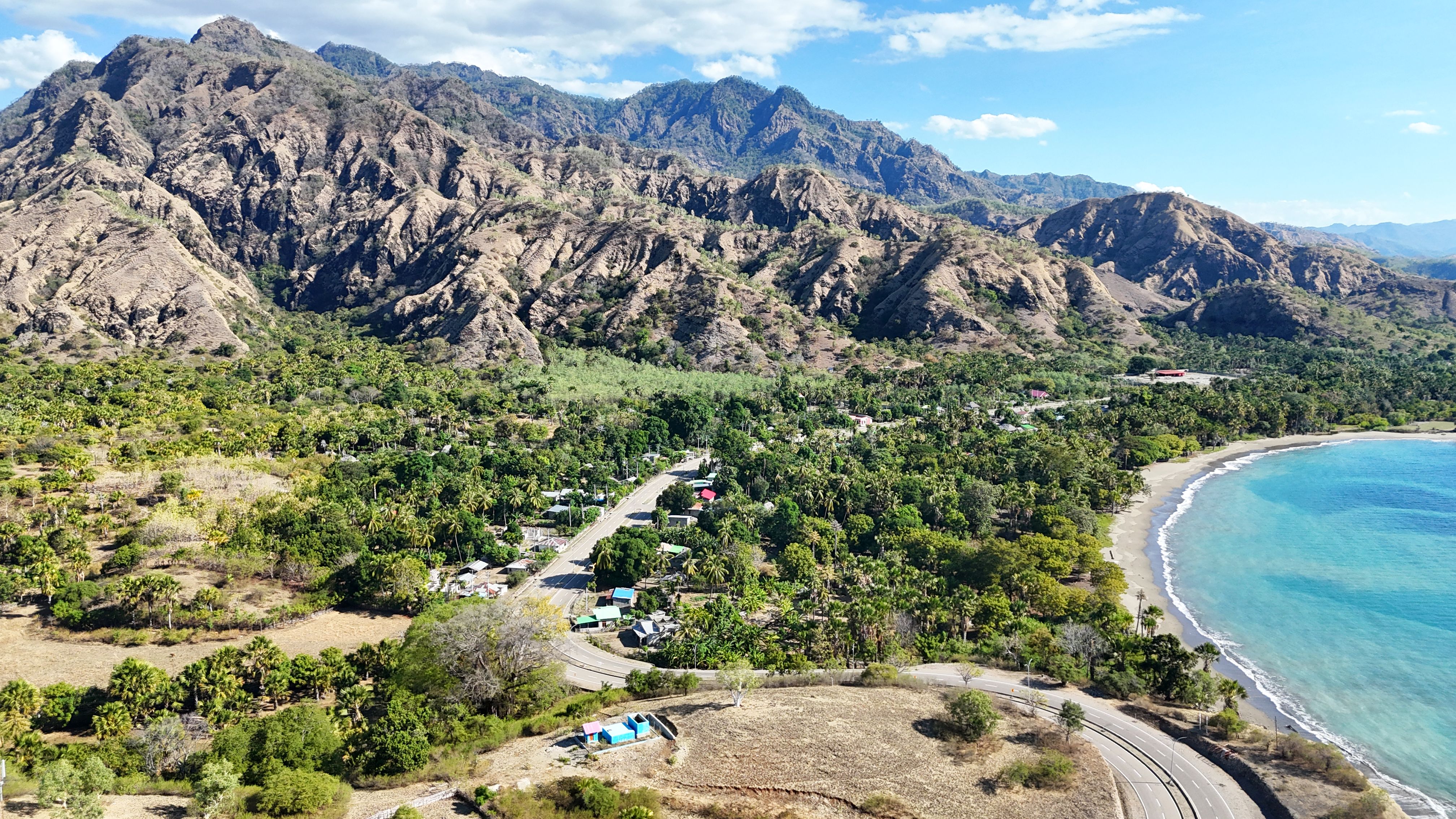
One of my favourite places I visited during my year in Timor-Leste was the enclave of Oé-Cusse, completely surrounded by Indonesia, but part of Timor-Leste. I spent a wonderful weekend exploring the main town of Pante Macassar and hiking in the hills behind. It was much cleaner, quieter, and better built (roads, airport, bridges) than anywhere else in the country, and was full of natural beauty.
Pante Macassar lies on the flat stretch between a seemingly never ending beach and stunning hills. It was a great place to fly a drone.


I never tired of the ever changing light on the craggy hills.


Nor the sunsets every night.


Oé-Cusse can be reached from Dili by a 12 hour drive (crossing the Indonesian border twice, which depending on your passport and visa may cost USD$35 each time!), 12 hour overnight ferry (often overcrowded, with sleeping options seats or the floor) or a 30 minute flight for $20 each way with Aero Dili. The later was the most attractive option!
I landed at Oé-Cusse International Airport, a symbol of questionable investment. This $119m modern international airport opened in 2019. It has a longer runway and better equipment than Presidente Nicolau Lobato International Airport in Dili, but a fraction of the passengers. Until early 2024 it was only served by light aircraft operated by ZEESM. Since mid-2024 it has been better served by Aero Dili flying twice times a week.


By the side of the airport was a rather forlorn looking arch marking Jardim Dos Heroes E Martre Da Patria. There are similar aches in Maliana and Same.

I got a good view of the new port from the air, with the relatively new ferry Ramelau moored for the weekend.


These are the remains of the previous port infrastructure…

Just beyond the western end of the airport is Lifau, where Portuguese explorers first landed on Timor Island in 1515. Originally marked by a pillar with Portuguese emblems (still standing to the west under a huge tree), the site was expanded in 2015 with a replica of a caravel and six golden figures re-enacting the first encounter. There was once a Portuguese Fort on the site, the first they built in Timor, but it was razed in 1769 and only an old piece of artillery remains on the site.


To the west of the monument site is the first of 14 Stations of the Cross marking the start of the Via Sacra Trail. This is a reasonably steep in places 30 minute walk uphill which offers possibly the best views of Pante Macassar. Every Good Friday thousands of people follow this trail.


Also to the west of the monument site were beautiful rice fields surprisingly close to the sea, whose scale can be best appreciated from the Via Sacra Trail.


Even further west is the unusual ‘tourist attraction’ of Ponte Noefefan. Opened in 2017, this $17m, 380m long bridge over the Tono River is largest in the country. It provides access to half of the Oé-Cusse to Pante Macassar and Dili. Previously around 3,600 families were isolated for much of the wet season by the raging river. It is formed of three green spans.


I needed to use my drone to fully appreciate the size and scale of the Tono River.


Heading back into the centre of Pante Macassar there was plenty more to explore. The main market in Pante Macassar is open every day but is at its busiest on Saturdays. It was atmospherically labyrinth like to explore.


Jardim E Parque Desportivo was a reasonably well maintained community sports area with a number of different pitches.


The Dominican Missionary Sisters Women’s College (Irmãs Dominicanas) was one of the first Catholic schools for women opened during Portuguese colonial times. It has beautiful gardens, and it is possible to stay there. Café Dominican at the southern end is a lovely place to relax and enjoy a drink or ice cream.


An unusual blue and white monument marks the Rotunda Rotunda de Ambeno roundabout. On the corner is impressive but half built and seemingly abandoned administrative building of Oé-Cusse. Koreans and Portuguese were involved in the development, which fell apart during Covid times.


Opposite the old harbour lies a memorial to five UN peacekeepers from Korea who died on 6 March 2003 when their vehicle was swept away while crossing the Ekat River in south Oé-Cusse. The memorial is in the shady and peaceful Parque Memorialda Korea Evergreen Force.


The somewhat mysterious Bersejarah Monument opposite the Parque Memorialda Korea Evergreen Force has seen better days but is well situated underneath shady trees.


There were statues of a couple in traditional Timorese clothing.


Opposite Pante Macassar’s waterfront, Kumando is a former Portuguese colonial administrative building that has seen better times, but is an atmospheric place to explore.


Opposite Kumando in an open air area by the waterfront is Estatue Nossa Senhora (Statue of Our Lady).


Built by the Portuguese in 1965, Igreja de Nossa Senhora do Rosário (Church of St. Antonio) is an attractive red and white church on the waterfront close to Kumando. It is particularly important during Easter, when a massive procession follows a life size statue of Jesus’ body that is carried on a special platform.


The Chapel of St. Anthony of Nispeno is second most important chapel for Catholics in Oé-Cusse, where the saint is celebrated every year on 13th June.


The Cave of Santo António Polsiba (Gruta St. Antonio) is the holiest place in Oé-Cusse, a small shrine located to the east of Pante Macassar at the foot of a hill. It represents where Saint Anthony is understood to have first appeared. It is reached by a small bridge from the road.


On a hill behind central Pante Macassar are the remains of the old Fatu-Suba prison and the residence of the Regional Administrator.


A statue of the Virgin Mary was added during the Indonesian occupation, to which a pilgrimage takes place every May.


Fatu-Suba is a good place to view Pante Macassar below and is a popular place to watch the sunset, though getting a clear view can be challenge. Just before Fatu-Suba is an observation deck shaped like the front of a ship.


The walk up passes the Chinese Cemetery.


Pante Macassar is a very spread out place, with little shade, so the electric tum-tums were the best way to get around.

The waterfront is rather lovely in many places though to explore.


To the east of town is Aosnak, one of the better beaches in Oé-Cusse.

The town looks equally stunning from the air.


Leave a Reply