One of my favourite parts of an 9 day, ~900km motorbike adventure around eastern Timor-Leste was along the rough roads from Laga to Baguia and back. The roads were challenging, but the scenery incredible, and there was plenty to explore.


East of Baucau, Laga had more to explore than it might initially seem driving along the quiet main road. The very blue São João Bosco church was built in the 1970s and rebuilt in the 1990s.

Across the road from it is a monument depicting Timorese being introduced to Catholicism by a Portuguese friar.

Take the parallel road up the hillside to the Portuguese era Forte de Laga, which follows the standard design of a square with two round corner towers.

On the corner of the main road to Lautém and to road south to Baguia are a series of 14 white crosses marking the Stations of the Cross.

At the start of the road to Baguia at Butufalu there are many Uma Lulik sacred houses built in a variety of materials, from traditional to modern.


Ten minutes drive up the road from Laga to Baguia lies the impressive new Jardim dos Heróis e Mártires da Pátria – Laga, a huge memorial to those who lost their lives during the struggle for Timorese independence from Indonesia.


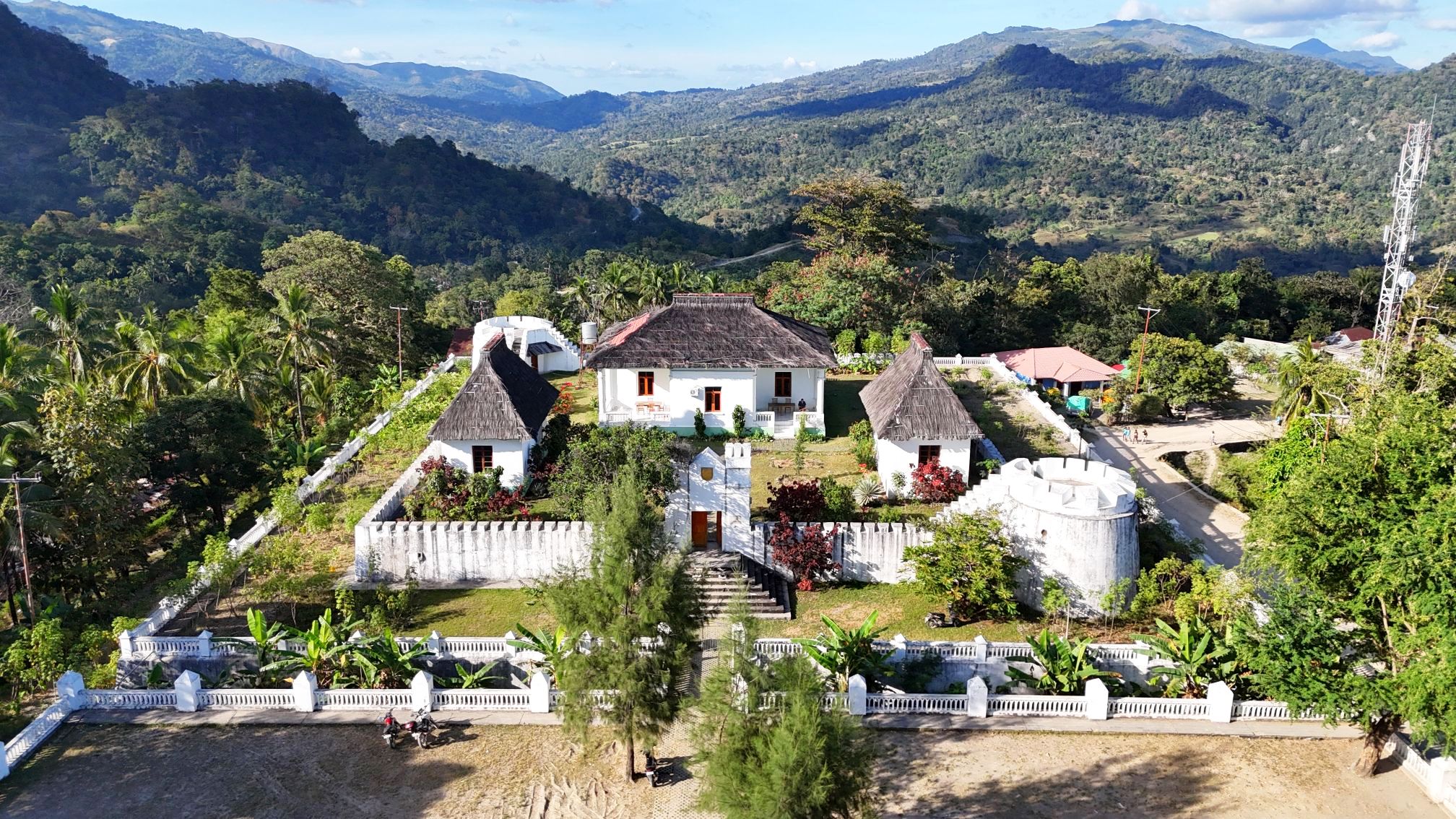
Baguia is home to a Portuguese fort turned hotel in 2014, which makes a good base from which to explore the Matebian area. The fort was built during the government of José Celestino da Silva (1894–1908). It has a double perimeter wall, with the inner wall home to two round corner towers. There is a further enclosed wall area at the front of the fort. Inside the inner wall are three buildings, two self contained rooms with en-suite facilities, and one main building with bunkrooms and facilities. During the Viqueque rebellion in early June 1959, at least a hundred insurgents attempted to take the fort, but were repealed by professional soldiers, though the fort was badly damaged.


When I visited there were popular cockfights taking place outside the fort.


Baguia Church was pleasant.


Baguia was a great place to watch the sun set and rise.


Matebian is the home to the second highest peak in Timor-Leste, the 2,376m Mane (male) peak. Neighbouring it is the 1,963m Feto (female) peak. Summiting either is significantly harder than Mt Ramelau, despite their lower height, due to both the terrain and logistics. Matebian is an important place for local Timorese as it is where their spirits and souls reside after death, and it was also one of the last holdouts of resistance by FALINTIL against the Indonesians. On October 10, 1993, a statue of Jesus Christ was erected at the summit to honor and protect the deceased. I’ll cover hiking to the summit of Mane in another post but here is a taster.


About a kilometre before reaching Baguia look out for Ruines de l’Escola do Reino de Haudère, atmospheric school ruins above the road on a small hill. The school was built in the 1920s and 1930s and badly damaged during WW2. It is now being reclaimed by nature, and is a photogenic place to visit.


Nunira is home to an attractively located blue, red and white church set back from the road, a number of Uma Lulik, and a small cemetery.


The views of the landscape were quite spectacular.

The Mercado de Terilodae are local markets with a view at one of the more open and scenic stretches of road between Laga and Baguia. The markets are held every Wednesday.


I never quite got a solid answer to what these are, but I’ve seen them throughout the country.


Sagadate and Lalulai churches are worth a quick look, as is the Siguilaba Monument relating to Timor-Leste’s independence struggles.


Leave a Reply