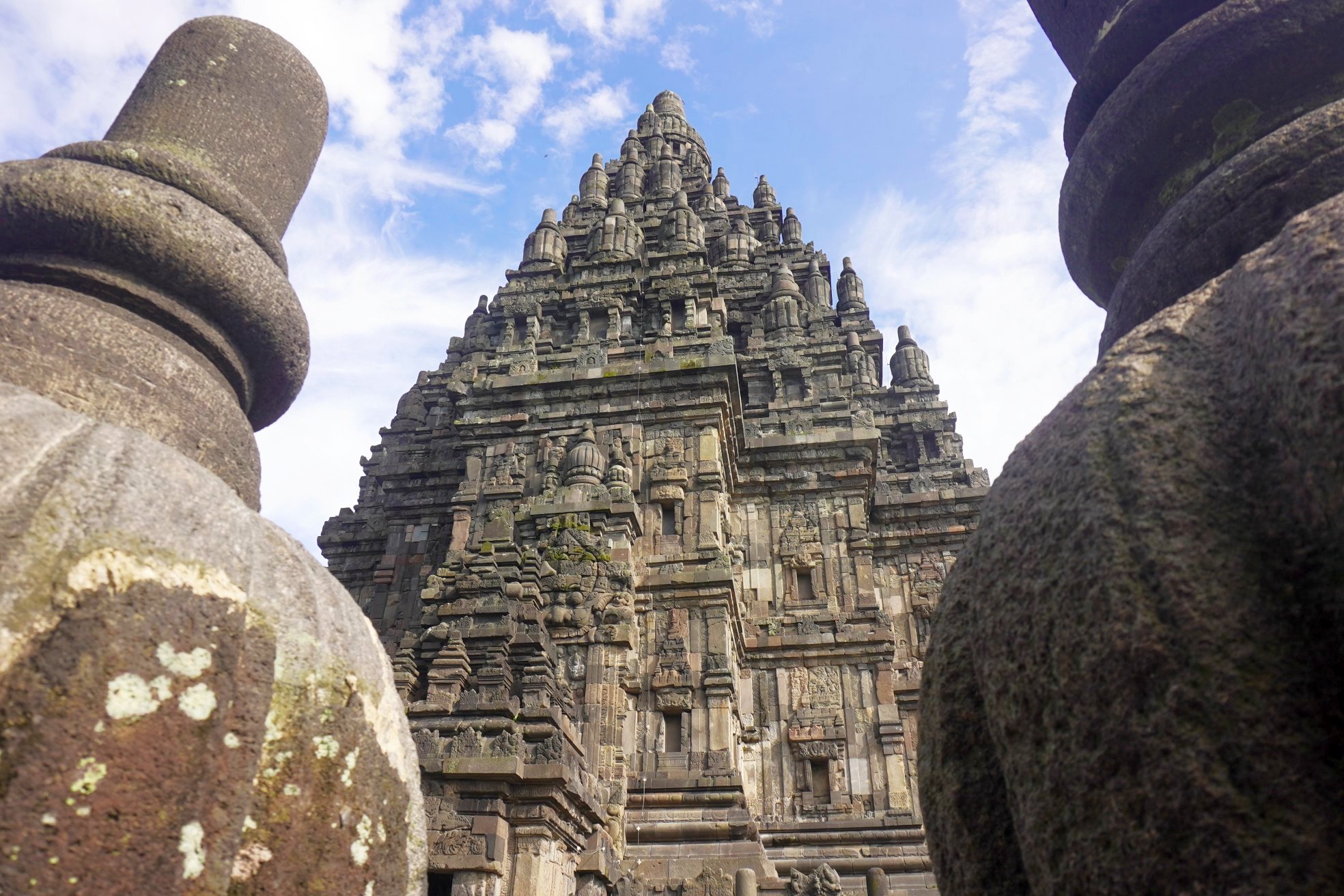
The second largest Hindu site in Southeast Asia, after Angkor Wat, Prambanan is understandably an UNESCO World Heritage Site, and is one of the most popular places to visit in Yogyakarta. It is a large site with four main temple complexes, the best known being the Prambanan Temple.


Built in the 9th century, there were originally 240 structures, most of which now remain piles of stones, but the main ones have been restored. The 47m Siva temple is flanked by the also sizeable Brahma and Vishnu temples, all of which can explored.


Inside are a number of statues to the various Hindu gods.


The exteriors are decorated with carvings.


In the distance, unusually visible for late December, in the middle of the wet season, could be seen Mount Merapi.

Drainage is critical to ensuring the temple remain well formed, and avoid their previous fate. Only temples where more than 75% of their original stones can be identified have been restored. It is quite incredible how these piles of stones are turned back into temple structures.


The Prambanan site is home to three more temple complexes within 10 minutes walk, though very few visitors seemed to be aware of this. I had two of the three completely to myself, and the third only had a handful of visitors, such a contrast from the hundreds of people at Prambanan, even at 8am. These were all local visitors though during the holiday season, I didn’t see any other Westerners in my entire visit.


Lumbung Temple is a lovely temple, built at a similar time to the other two described below, in the 9th century but earlier than Prambanan temple. These three temples are also Buddhist, rather than Hindu.


Bubrah Temple was one of the last to be restored, with reconstruction taking places between 2011 and 2017.


Sewu Temple is the second largest Buddhist site in Indonesia, after the famous Borodudar, which is about 2 hours drive west of Prambanan. It is a large complex, originally home to 249 temples, but only the main ones have been restored.


I enjoyed visiting it more than Prambanan Temple in many ways, with almost no else around, and it was quite atmospheric how the central 30m high temple is surrounded by endless piles of stone.


It was built in the 8th century, pre-dating both Prambanan Temple and Borodudar.


Close by is a smaller museum explaining the reconstruction techniques.


Which was less atmospheric but more informative than the main Museum Candi Prambanan, where the text is all in Indonesian.


Getting out Prambanan was more challenging than expected, as you’re funneled through endless shops and markets…


Leave a Reply