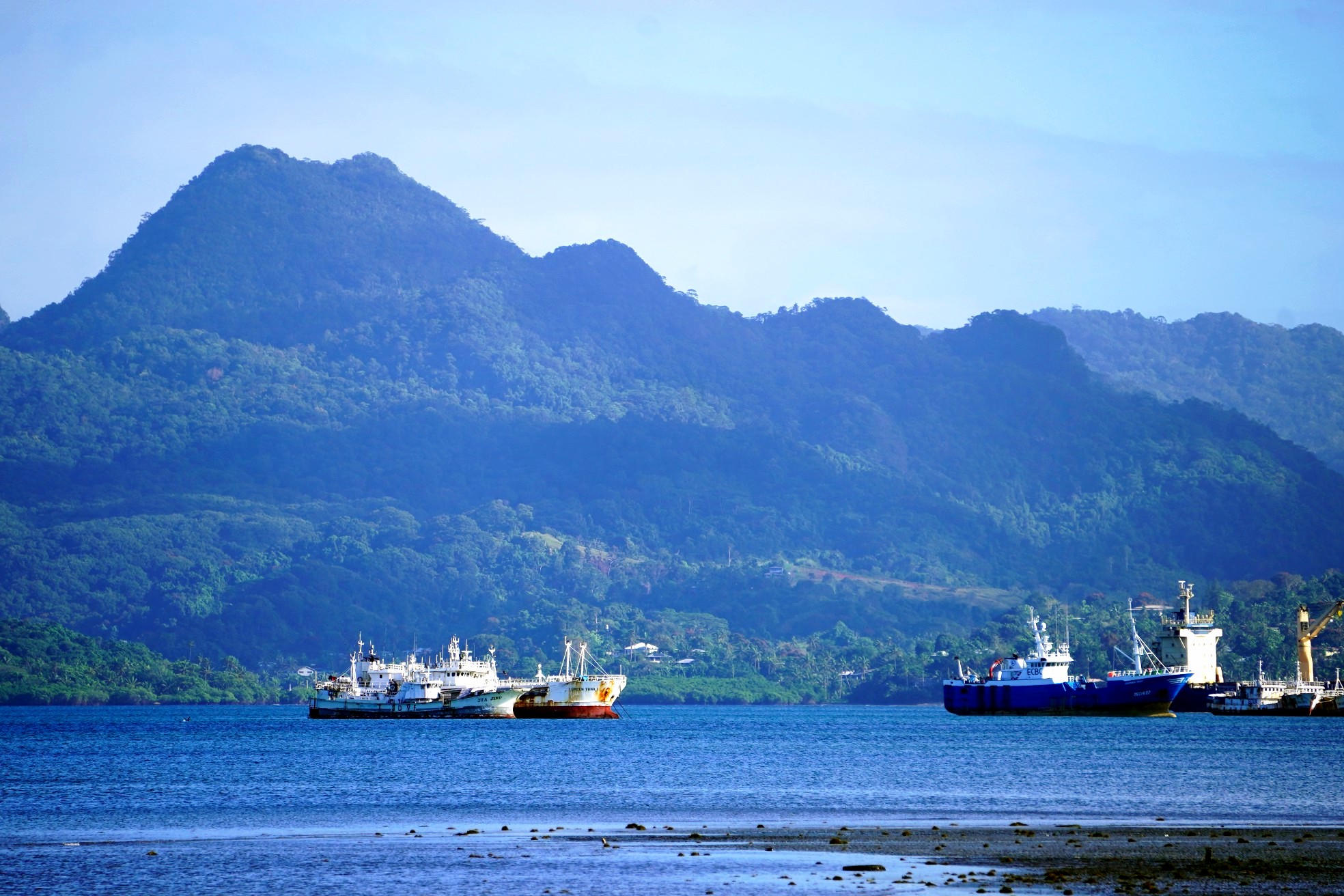
I’ve been in Fiji for a week now, so thought it’d be a good time to share my initial impressions of the country. I previously visited Fiji in 2013 for a diving holiday at Volivoli Beach Resort, which is by far the more common visitor experience. This time I’m moving to Fiji, to live in the capital Suva, to support my partner as she volunteers through Volunteer Service Abroad. Comparisons have been inevitable for me with Timor-Leste and Samoa, as small developing island nations in Asia-Pacific where I’ve recently spent a significant amount of time.
On the Road to Suva
Fiji’s international airport is in Nadi, which is the opposite side of Viti Levu, the largest Fijian island, from Suva. There are small plane flights that cross the island, but I took a four hour road transfer, giving me an initial glimpse of the country.
The Viti Levu landscape changed notably heading from the west to east coast, being much drier and relatively flatter around Nadi, becoming much lusher and more typically tropical from Pacific Harbour onward, about 45 minutes west of Suva.


Fiji is just as religious as Samoa or Timor-Leste, i.e. pretty much everyone is religious, primarily Christian, but there are also significant Hindu and Muslim populations. However I saw far fewer religious sites between Nadi and Suva. Every village in Timor-Leste has a church, and in Samoa every village has half a dozen churches, but they rarely appeared driving across Viti Levu. There were also far fewer cemeteries visible from the road, other than a large one entering Suva.
Village houses appeared to primarily be built of breeze blocks, concrete, wood and corrugated metal. I don’t think I saw a single thatched roof or traditional style building.


Billboards are everywhere, and many familiar Pacific brands make an appearance – Vinod Patel hardware stores, Vodafone, Digicel, DMC, and FMF (Flour Mills of Fiji). The latter sponsor the signs that mark each village, they don’t just make flour, but are larger suppliers of rice, split peas, noodles, oil, chips, biscuits, milk and tea, and detergent!


I saw less rubbish alongside the road and in Suva than Timor-Leste, but more than Samoa, and the villages were less distinctive and decorative.
Tourism in Fiji largely revolves around upmarket resorts, which are expensive and really not my thing. There are adventures to be had, but many of the sights are on the other side of Viti Levu, close to Nadi, or on the other islands (there are 330 of them!), which are generally more accessible from Nadi. I don’t think it’ll offer the opportunities for independent travel that Timor-Leste and Samoa allowed. Annually Fiji gets around a million visitors, Samoa gets about 200,000, and Timor-Leste less than 25,000…
Life in Suva
Suva is often described as the capital of the Pacific, being one of the largest urban centres, with ~180,000 people in the greater area, home to over 20,000 students at the University of the South Pacific, and it hosts the Pacific Islands Forum Secretariat, the main regional political body for Pacific nations, and many UN agencies focused on the Pacific. There must be a lot of expats in Suva working at these organisations, but I’ve only seen them in the upmarket Flagstaff area. Unlike me I suspect they not catching local buses or exploring the bargain shops downtown…


One of the best things about Suva is the climate, being far cooler and breezier than Timor-Leste’s capital Dili, and even Samoa’s capital Apia, though Suva is wetter than both, and apparently during the wet season (November-April) it rare to see the sun, with thick cloud cover.
Another great thing is that there appear to be far fewer dogs around, particularly compared with Timor-Leste and Samoa, where they were a constant presence, and often aggressive if you went anywhere near houses. The relatively few dogs I’ve seen in Suva have been much more relaxed, making running a much less stressful experience.
Almost everyone seems to speak English, which makes things a little easier…
Fijians appear to love a good parade. On Saturday Maha Ganpati Utsav was a public celebration of the Hindu festival of Ganesh Chaturthi, which culminated in processions around Suva and the immersion of Lord Ganesha idols.


I’ve seen almost no street art in Suva, these were the only examples I’ve found.


Mobile technology is well integrated into daily life. Both Vodafone and Digicel have apps that allow people to manage money that are accepted at most places in Suva. Cash is still important, but much less so than in Timor-Leste or Samoa. The local buses don’t even accept cash, everything is done through an electronic bus card.
The buses in Suva are cheap and efficient, but there are no route maps. They’re way more spacious and comfortable than microlets in Dili, despite the loud engines, and even louder music, helped a little by surprisingly decent sound systems.


Taxis are also cheap and plentiful, and there are decent pavements for walking around the city, particularly along the scenic sea wall around the southern half of the city.


There are a number of beggars on the streets in Suva, which I never saw in Apia or Dili, and I generally don’t feel as safe, which is backed up by the crime statistics. It’s not Port Moresby, Papua New Guinea’s notoriously dangerous capital, but I’m definitely taking more care. There are only two hikes near Suva, and both have had reported incidents of people being robbed. It is largely young men, with alcohol frequently an influence, and the relatively greater number of tourists (particularly when cruise ships arrive in Suva 4-5 times a month) offer more targets.
Other than on Sundays, downtown Suva always seems super busy, with far more people on the streets than in Apia or Dili (a larger city). Visiting a supermarket on a Saturday morning was the only time I’ve experienced a shopping trolley shortage.

The main markets in Suva are wonderful, with a great range of produce, and good prices which are handily displayed unlike most similar markets I’ve visited.


Leave a Reply