The capital and only city in Samoa, Apia is an enjoyably low key place to visit. It is home to around 40,000 people, about 20% of the Samoan population, and though many visitors head directly to resorts, it is well worth a couple of days to explore.
To start with Villa Vailima, the beautiful former home of Robert Louis Stevenson, author of Treasure Island and Dr Jekyll and Mr Hyde, who spent the last four years of his life in Samoa. After his death the house was occupied by German and New Zealand governors, and the Samoan Head of State. It was badly damaged by cyclones in 1990 and 1991, and rescued by an American businessman who spent a couple of years as a Mormon missionary in Samoa 40 years earlier. It is now a well presented museum and a highlight of visiting Apia.


Robert Louis Stevenson died in 1894 and requested to be buried at the summit of the 472m high Mt Vaea, the most prominent peak near Apia. There is a great hike to the summit from his house, through beautiful rainforest, almost entirely in shade, but still hot work in the tropical climate. Expect to see plenty of Black Skinks along the way.


There are two routes, a more direct and steeper one with lots of steps, and a longer but more gradual one which is actually trickier in someways as it can be slippery and there are many tree roots. It seems that almost everyone takes the direct route. It is a popular exercise spot for locals, best tackled first thing in the morning or at the end of the day.


At the base is a small waterfall and refreshing pool during the wet season (November to April), which is the ideal spot for a refreshing dip, though it soon disappears in the dry season.

The walk can also be started from the lovely 30 acre Vailima Botanical Garden, established in the early 1900s.


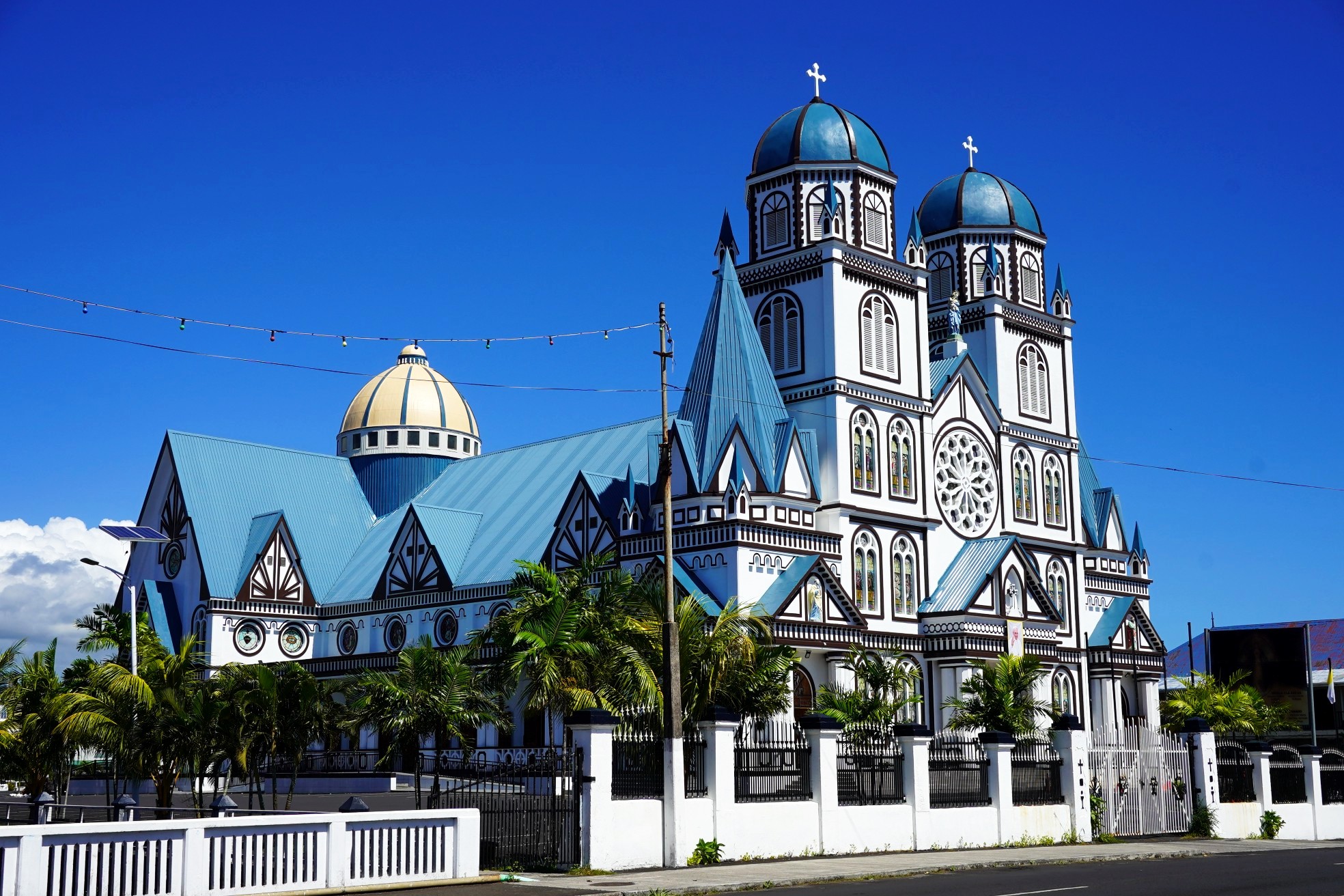
Heading to the centre of Apia, and its most prominent landmark, the stunning Immaculate Conception Cathedral. It opened 2014, replacing the 143 year old previous cathedral that had been damaged by an earthquake in September 2009. It an exquisite building with many attractive details.


Opposite is the Samoa Visitor Information Centre, which had welcomingly strong air conditioning, and destinations pole outside.


Behind is a lovely area where the Samoa Women’s Association of Growers markets are held every Saturday.


I initially thought this was a hotel but it is actually offices of the Samoan Government.


Behind is the lovely Matagialalua Friendship Park which is popular with locals in the evenings, with walkers and runners heading along by the sea wall.


There were some interesting creatures in the mud at low tide.


Every weekday morning around 8.45am the Samoan Police march from the station to outside the government offices to raise the national flag, very enjoyable to watch.


Apia Clock Tower was built in the 1920s as memorial to Samoan soldiers who died during WW1, and primarily functions now as the busiest roundabout in Samoa.


Next to it is Nelson Memorial Public Library, the main library in Samoa, dating from 1960.


The nearby fish markets are fascinating for the variety of sea life on sale, thankfully described on a central column. It was quiet when I visited on a weekday, Sunday morning is the busiest time.


There are a few significant buildings, including the flash Central Bank of Samoa.


The Samoa Independent Seventh Day Adventist Church looked impressive from the outside, not quite as much on the inside.


Few photos to give a feel for downtown Apia, it’s a pretty small place!


To head inland, which is hot work on foot as there is almost no shade, though there are generally reasonable pavements. There were views of Mt Vasa in the distance, and the interesting European Cemetery.


Further on is the Museum of Samoa. It was previously housed in a former German colonial school building, but in 2020 moved next door into a very flash complex. Unfortunately the vast majority of the space is taken up by government offices, and there are just two small rooms with displays, many of which are from across the Pacific, rather than specifically Samoa.


Walking west there were some attractive fruit and vegetable markets between Vaea St and Saleufi St.


Fugalei Market is the main place for fresh produce and clothes in Apia, a huge covered market which was much calmer and tidier than most similar markets I’ve visited.


Next to it is one of the main bus depots, where these colourful if somewhat uncomfortable buses leave for destinations around the island.


The Mulinu’u Peninsula is a pleasant place to explore on foot, particularly walking along the sea wall.


It is home to government buildings including Fono – the Parliament of Samoa, Samoa Ministry of Justice and Courts Administration Court House, and Tofilau Eti Alesana Government Building. The Samoan parliament building opened in 2019, replacing the previous building that dated from 1962. The new building was gifted by the Australian government to celebrate 50 years of Independence.


There are also a number of tombs, including to Malietoa Tanumafili II, a Samoan paramount chief and politician who was O le Ao o le Malo (head of state) of Samoa from its independence in 1962, until his death in 2007.


Plus memorials to the 1955 sinking of M.V. Joyita, British and American sailors who died in 1899, and a German lieutenant. Further around the waterfront to the east is a memorial to early missionary John Williams.


At the eastern end of the waterfront is the Sheraton Samoa Aggie Grey’s Hotel & Bungalows, an historic hotel opened in 1933, and part of the Sheraton group since 2016. It is near a river mouth flowing into the sea, mixing salt water and fresh water.


In western Apia is the impressive Church of the Later Day Saints (Mormon) Temple. There are many Church of the Later Day Saints (Mormon) chapels in Samoa, but only one temple, and it can only be entered (like all Mormon temples, but not chapels) but people of high standing in the church. Opened in 1983, it was the 22nd in the world, and 3rd in Polynesia after Hawaii and New Zealand. It was destroyed by fire in 2003 but rebuilt and opened in 2005.

Heading up the hill on the Cross Island Road to the beautiful Shrine of the Three Hearts, a huge Catholic church opened around 2010, with some of the best stained glass I’ve seen in Samoa.


In front of the church is a huge fale and perhaps the best views in Apia.


Further up the road is the lovely Baha’i House of Worship Samoa. Opened in 1984, it is one of only eight such buildings in the world. Costing $6.5m it seats up to 700 people, in the distinctive nine sided building. The grounds are immaculately kept, even by the high standards of gardens in Samoa.


Next door is the Tiapapata Art Centre, established in 1989. The complex includes a great cafe, artist studios, three AirBnB units, an art gallery and a fale. It is noticeably cooler up here compared with downtown Apia, quiet and peaceful.


Continuing up the road into the mountainous centre of Upolu, the most populous Samoan island. Mt Fiamoe is a 938m high volcanic peak, easily accessed along a rough 4WD track to the crater rim. I visited it twice, but unfortunately both times it was in torrential rain (clear skies in Apia below!) so I couldn’t see much.


Another 10 mins drive up the Cross Island Road is the 100m Papapapai-Tai Falls, the highest waterfall in the country, though I could barely see it through the rain. Judging by this nearby sign visibility can often be an issue here…


Leave a Reply