The appropriately understated capital of Finland, Helsinki reminded me of a smaller version of Stockholm. It was a pleasant place to explore for a couple of days but didn’t particularly excite despite lots of attractive architecture.


The train station completed in 1919 is one of the icons of the city.


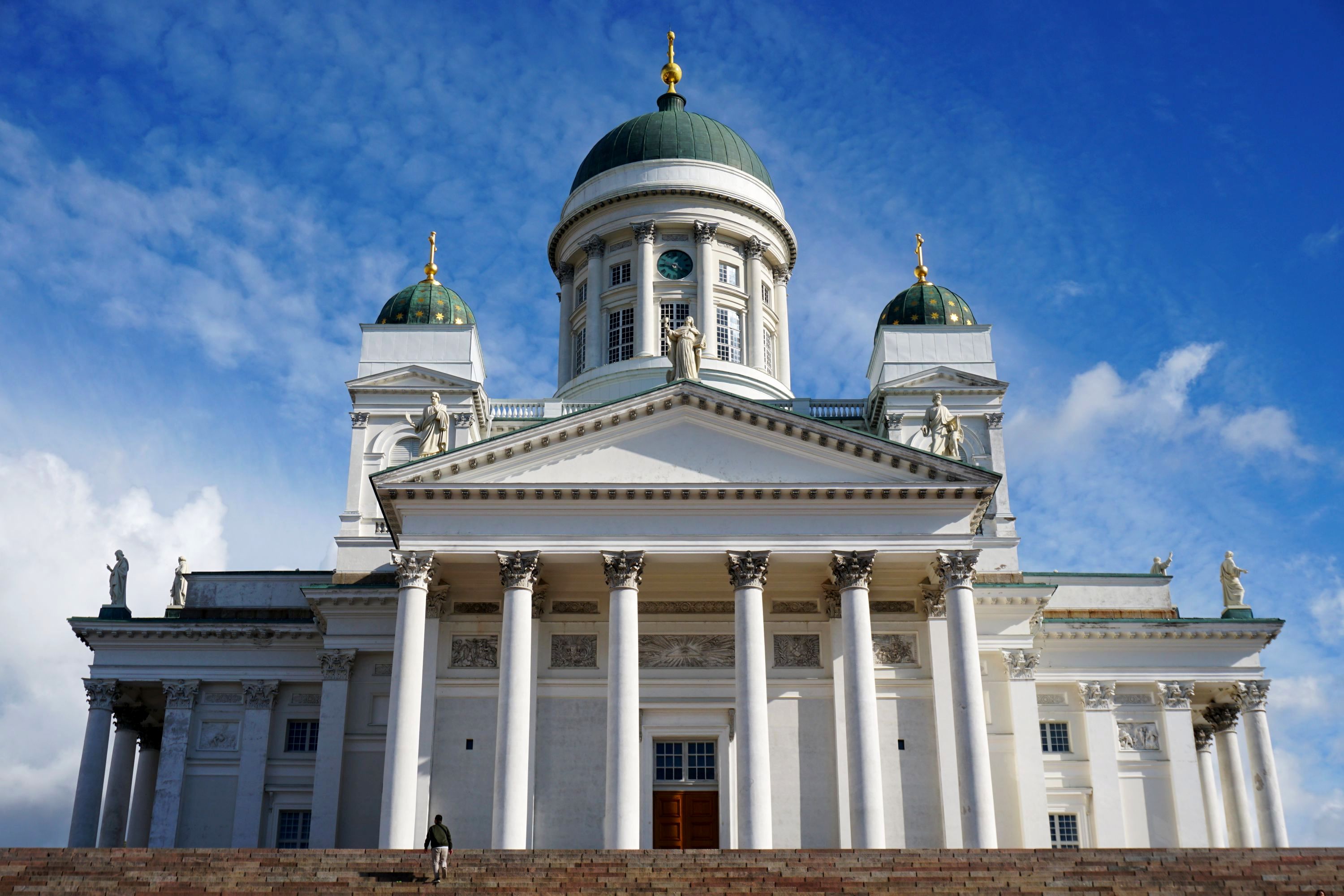
At the heart of Helsinki is Senate Square, and the iconic white Helsinki Cathedral completed in 1852. The inside of the cathedral was plain, very Lutheran.


In contrast with the ornate 19th century orthodox Uspenski Cathedral close by.


A highlight of my time in Helsinki was catching the ferry over to Suomenlinna, a nearby island home to one of the largest sea fortress complexes in Europe, built by the Swedish in the mid 1700s to unsuccessfully protect against the Russians, who took control in 1808.


Suomenlinna Church is a prominent landmark on the island, visible from the mainland. It was the first church I’ve visited surrounded by a fence made of cannons. Originally it was far more orthodox in design (and more attractive) but it was converted to serve a dual purpose as a lighthouse.


Submarine Vesikko was Finland’s last submarine, dating from WW2. Manned by a crew of 20 it was typically claustrophobic inside.


The Military Museum of Manège was better than expected, documenting Finland’s involvement in conflicts, in particular when it bravely fought back the Soviets in 1940. There was an interesting section on life as a conscript, and comparison of the Finnish military with Sweden, the US, and Russia. The Finnish military isn’t large but is regarded as one of the best in Europe, motivated by its proximity to Russia.


Kustaamiekka, at the southern end of the island, was an interesting combination of dunes and fortifications.


Helsinki City Museum was the most underwhelming museum of my whole trip to Scandinavia. There just wasn’t much there, other than a decent scale model of the city a hundred years ago, and a couple of semi-interesting exhibits.


Much better was the National Museum of Finland, which told well the story of the country, with a well displayed collections.


The Helsinki Central Library Oodi is a good example of a modern library, with the public able to use / borrow 3D printers, musical instruments, and computer games, as well as books. It has a outside viewing area, indoor trees, and funky taps in the unisex bathrooms.


Lasipalatsi Square was very cool, though I’d be surprised if people haven’t hurt themselves climbing over these features, they’re pretty steep!


The famous Temppeliaukion Church was dug down into rock in 1969, creating an unusual space and a seemingly popular tourist attraction.


The Helsinki Old Church dates from the early 19th century and is Helsinki’s oldest church in the city centre. Like Helsinki Cathedral is it relatively simple and plain inside.


To finish with the rather pleasant Kaisaniemi Botanic Garden, known for its sizeable greenhouses.


Leave a Reply